National Dementia Diagnostics Laboratory
About us
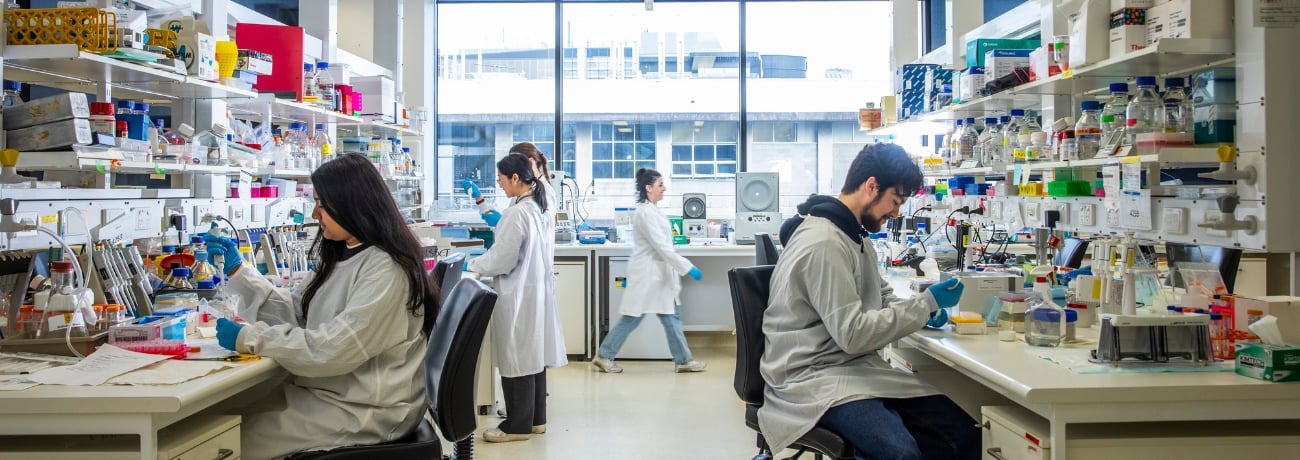
The National Dementia Diagnostics Laboratory (NDDL), located at The Florey, is a NATA/ILAC accredited pathology testing laboratory.
The NDDL is the only accredited pathology testing laboratory in Australia that provides cerebrospinal fluid (CSF) diagnostic testing for Alzheimer’s disease (AD) and Creutzfeldt-Jakob disease (CJD).
The NDDL provides diagnostic services to the medical community, scientific researchers and the pharmaceutical industry and is a collaboration between The Florey and the University of Melbourne.
CSF test for AD
The Cerebrospinal Fluid (CSF) Assay for Alzheimer’s Disease (AD) is an ante-mortem diagnostic test that detects alterations in biomarker protein levels, Abeta1-42, phospho-tau (P-tau181), and total Tau (T-tau) in fresh CSF, which are reported to be directly related to the pathophysiology of the disease. These CSF biomarkers oƯer ~90% sensitivity and specificity for early diagnosis of Alzheimer’s disease.
Neurofilament Light
Neurofilament light chain (NfL) is a non-specific biomarker of central nervous system neuronal injury. It is used together with clinical correlation.
Elecsys® quantitative immunoassay for NfL is available for both CSF and plasma with National Association of Testing Authorities (NATA) accreditation. Values determined on samples by different assay methods may not be used interchangeably.
CSF Samples
- Must be accompanied by AD CSF Specimen Data Sheet.
- Must be collected directly into the blue capped tube (Sarstedt 63.614.625), following the guidelines on page 2 of the AD CSF Specimen Data Sheet. DO NOT FREEZE the sample under any circumstance. CSF collected into any other tube type is considered unsuitable for Abeta1-42 only.
- CSF in the blue capped tube is also suitable for NfL and CJD biomarker testing.
- Single tube is suitable for multiple protein testings.
CSF tests for CJD
These tests include the National Association of Testing Authorities (NATA) accredited CJD biomarker panel ( 14-3-3 ELISA and RT-QuIC assay).
As CSF 14-3-3 and total-tau proteins provide similar sensitivity and specificity for the diagnosis of CJD, from 1 June 2024 CSF total-tau measurement is no longer included as part of the CJD CSF biomarker panel.
Plasma tests
Phospho-Tau (217P) (NATA accreditation pending)
Elecsys Phospho-Tau (217P) Plasma (pT217p) is an in vitro quantitative immunoassay intended for the determination of the phosphorylated Tau217 protein in human plasma from individuals aged 55 years and older. In May 2026, it was granted TGA approval for blood samples. Each sample must be accompanied by NDDL Plasma Specimen form. In July 2026, Roche Diagnostics received TGA approval to supply the Elecsys pTau217 blood test.
The assay is intended for use as an aid in identifying patients with amyloid pathology presenting with signs, symptoms, or complaints of cognitive decline associated with Alzheimer’s disease.
A positive Elecsys Phospho-Tau (217P) Plasma assay result indicates a high likelihood of amyloid pathology. This result, in the absence of clinical evaluation, does not establish a diagnosis of Alzheimer’s disease. An intermediate Elecsys Phospho-Tau (217P) Plasma assay result is indeterminate for the presence of amyloid pathology. It is recommended to consider these patients for further testing. A negative Elecsys Phospho-Tau (217P) Plasma assay result indicates a low likelihood of amyloid pathology. Further clinical investigation into other causes of cognitive decline is recommended for these patients.
The Elecsys Phospho-Tau (217P) Plasma assay result must be used in the diagnostic pathway in conjunction with other clinical information.
Phospo-Tau (181P) (for the exclusion of AD)
Elecsys Phospho-Tau (181P) Plasma (pT181p) is an in vitro quantitative immunoassay intended for the determination of the phosphorylated Tau 181 protein in human plasma. It is the first TGA approved blood test since September 2025. Each sample must be accompanied by NDDL Plasma Specimen form.
The Elecsys Phospho-Tau (181P) Plasma assay result is intended to be used as an aid in the initial assessment for Alzheimer’s disease and other causes of cognitive decline in adult patients aged 55 years and older, presenting with signs, symptoms, or complaints of cognitive decline. A negative Elecsys Phospho-Tau (181P) Plasma assay result is consistent with a negative amyloid positron emission tomography (PET) scan or cerebrospinal fluid result and with a reduced likelihood that a patient’s cognitive impairment is due to amyloid pathology. It is recommended to investigate these patients for other causes of cognitive decline. A positive Elecsys Phospho-Tau (181P) Plasma assay result is not necessarily consistent with a positive amyloid PET scan result. It is recommended to further investigate patients with an initially positive result to determine whether amyloid pathology could be a cause of the cognitive impairment.
Limitations of use: The Elecsys Phospho-Tau (181P) Plasma assay result must be considered as an aid in the diagnosis of Alzheimer’s disease in conjunction with other clinical information.
Samples handling and transportation
- Each sample must be accompanied by a signed copy of the doctor’s request and a completed NDDL CSF Specimen Data Sheet or Plasma Specimen data sheet with details pertinent to the sample and invoice details.
- If the CSF specimen is collected in a private imaging facility/theatre and is being forwarded directly to the NDDL for testing and not via a pathology laboratory, the collecting facility is responsible for sending the specimen secured in double specimen bags with padding to NDDL, using overnight express service such as prepaid Australian Post, which has a tracking number. The sender must send an email to [email protected] notifying the tracking number.
- One plasma tube (2-3ml) is suitable to perform multiple protein testings.
- A pathology laboratory that is referring the sample for testing is responsible for organising a courier service to collect and deliver the CSF (cool pack, not frozen) or plasma sample (dryice) to NDDL.
Testing fees
The Alzheimer’s disease, neurofilament, plasma pT181p and plasma pT217p test fees are not covered by Medicare. For private patients, a signed payment agreement for the test on the request form is required.
The Alzheimer’s disease biomarker test includes Abeta1-42, P-tau and T-tau and the cost is $400.
The cost for the Neurofilament Light chain testing is $250 for CSF and plasma, $200 if combined with Alzheimer’s disease, pT181p or pT217p tests.
The cost for plasma Phospho-tau (181P) (pT181p) is $250 from 1/1/2026.
The cost for plasma Phospho-tau (217P) (pT217p) is $350 (NATA accreditation pending).
CJD Biomarker testing for domestic samples will incur a fee of $250 from 01/08/2026. International samples incur a fee of $AUD 500.
Testing schedule
The AD CSF, Neurofilament and Plasma Phospho-tau (181P) and Plasma Phospho-tau (217P) tests are performed weekly.
The 14-3-3 ELISA and RT-QuIC is performed weekly on a Monday.
Holiday period closures: NDDL is closed on the below days. Please hold all diagnostic samples for AD biomarker testing at 4° Celsius during affected periods.
- National and Victorian public holidays
- Christmas and New Year period: 25 December to early January
- Easter: Good Friday to the following Tuesday
- Melbourne Cup Carnival: Monday and Tuesday of the first week in November
Clinician resources
In May 2024, Roche hosted a series of educational evenings around Australia to shine a spotlight on the changing landscape of Alzheimer’s disease in Australia. Several Australian Alzheimer’s disease experts shared the latest information on the importance of early and accurate diagnosis, upcoming treatments and Australia’s readiness for their arrival. Visit the Roche website to access the recordings.
Publication (2024): Using cerebrospinal fluid biomarkers to diagnose Alzheimer’s disease: an Australian perspective
Further information (2025): Roche Elecsys® pTau181 plasma announcement
Further information (2026): Elecsys pTau (217P) Plasma Brochure
Find out more about CJD testing at the Australian National CJD Registry.
Contact
NDDL – AD Biomarker Test
E [email protected]
P +61 3 9035 7243
F +61 3 9349 5105
CJD Biomarker Test
E [email protected]
P +61 3 8344 1949
F +61 3 9349 5105
Delivery
Attn: NDDL-AD and/or ANCJDR
National Dementia Diagnostics Laboratory
The Florey
Kenneth Myer Building
30 Royal Parade (corner of Genetics Lane)
Enter via Gate 11, rear loading dock
Parkville Victoria 3010
The sample reception at the loading dock is open from 8am-4pm. The NDDL is closed on public holidays. Please hold all diagnostic samples for AD biomarker testing at 4 degrees Celsius during affected periods. CJD diagnostic samples should be stored frozen during closure periods. Contact the relevant testing group for further information.
NDDL management
Professor Steven Collins – Director/Designated person
Associate Professor Nawaf Yassi – Co-director/Designated person
Associate Professor Qiao-Xin Li – Co-Manager AD
Dr Christiane Stehmann – Co-Manager CJD
Ms Shannon Sarros – Quality Manager
Research and postdoctoral fellows
Dr Laura Ellett – Research Fellow
Research and technical staff
Ms Amelia McGlade – Research Assistant CJD
Ms Shiji Varghese – Research Assistant AD
Ms Priscilla Agustina – Research Assistant
Complaints
Complaints about the NDDL operations can be forwarded to the NDDL Director, Professor Steven Collins.
Complaints related to the NDDL research specific operations or potential breaches of ethical responsibilities can be forwarded to the University of Melbourne’s Human Research Ethics Committee:
Manager
Human Research Ethics Office for Research Ethics and Integrity
The University of Melbourne VIC 3010
T 03 8344 2073
E [email protected]