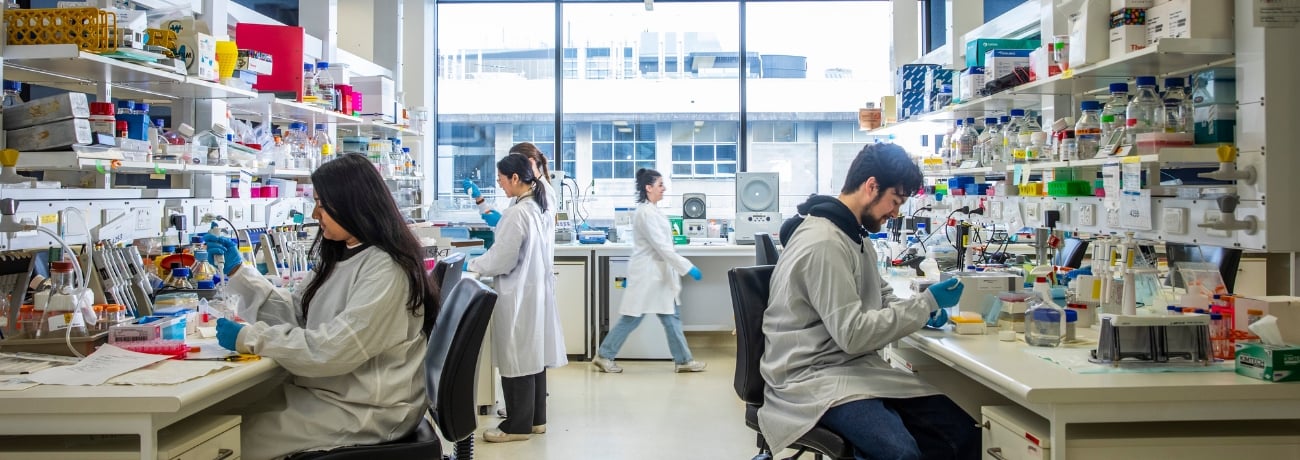
- Three Florey researchers are among this year’s recipients of FightMND grants.
- Their projects aim to improve understanding of motor neurone disease (MND).
- FightMND has allocated a record $30.6m to 69 research and care projects in 2026.
A senior, a mid-career and an early-career researcher from The Florey Institute of Neuroscience and Mental Health have been awarded FightMND grants to continue the fight against motor neurone disease (MND).
The Florey’s successful recipients are Professor Clare Parish, Associate Professor Samantha Barton and Samuela Pasculli.
Each scientist is working with tiny 3D organoids, or ‘mini brains’, grown in the lab using reprogrammed human stem cells from MND patients to model and study the disease in detail.
Understanding human neurovascular dysfunction in MND
Professor Parish, a leading stem cell scientist and Deputy Director at The Florey, has been awarded a FightMND Discovery Grant.
Her team’s project will use ‘mini brains’ that include blood vessels to understand how changes in the vasculature affect neurons and how neurons impact the vessels.
“This is important as vascular changes have been observed in MND patients, with evidence that these changes precede the neuron death,” Professor Parish said. “Greater understanding of these processes may present new targets for therapeutic intervention in the future.”
Using organoids to advance understanding of MND
Associate Professor Barton has received the FightMND Mid-Career Research Fellowship.
Growing ‘mini brains’ in the lab using stem cells reprogrammed from MND patients’ own cells gives researchers a window into how cells interact and degenerate to cause MND.
The fellowship will allow Associate Professor Barton to investigate the disease in different cell types and help establish a drug screening platform based on identified cellular pathways.
Using organoids to understand TDP-43 pathology
Samuela Pasculli, a PhD student in the Myelin in Health and Disease Group, is this year’s recipient of the FightMND Angie Cunningham Biomedical PhD Scholarship.
Ms Pasculli said she was grateful to receive her first FightMND scholarship, which will support her research into the cellular mechanisms of MND.
“As an international PhD student, this scholarship means a great deal to me and I’m incredibly grateful to FightMND for supporting my research and giving me the opportunity to contribute to this important work.”
In almost all cases of MND, a protein called TDP-43 accumulates abnormally inside cells, forming clumps that are associated with damage to the nervous system. While MND is often discussed in terms of the loss of motor neurons, other brain cells, known as glia, may also play an important role in the disease.
Ms Pasculli’s research will use stem cells to grow 3D models of the human spinal cord and induce TDP-43 accumulation. By investigating how TDP-43 pathology affects different cell types, particularly glial cells, her project aims to uncover how these cells contribute to MND and provide new insights into the mechanisms underlying disease progression.
“MND has a devastating impact on the lives of people affected by the disease and their families and there is still so much we need to understand,” Ms Pasculli said.
“I’m particularly interested in looking beyond motor neurons and understanding how other cells in the nervous system, such as glial cells, contribute to the disease. Advances in stem cell technology give us exciting new opportunities to study MND using human cell models and bring us closer to understanding what goes wrong.”
FightMND was established in 2014 with the aim of finding effective treatments and ultimately a cure for MND. FightMND co-founder and former AFL player Neale Daniher AO lost his battle with MND in May after living with the disease for more than a decade.