Animal use at The Florey
The use of animals in scientific research is vital to the advancement of human health. At The Florey, this research gives us an understanding of mental health and neurological conditions and facilitates the development of life-saving interventions that would otherwise not be possible. All research involving animals must adhere to strict ethical and regulatory requirements and is reviewed by an Animal Ethics Committee to ensure it is scientifically valid, ethically sound and meets the expectations of the broader community.
Animals used in research are specifically selected for their ability to adapt to different environments, and for their anatomical, physiological and genetic similarities to humans. This includes mice, rats, sheep and clawed frogs.
We recognise that animals are sentient beings with intrinsic value and it is a privilege to use animals for scientific purposes. We are committed to ensuring that the animals are treated with respect and maintain high standards of animal care and welfare throughout every step of the process.
Our commitment to openness
The Florey is proud to be a signatory to the Openness Agreement on Animal Research and Teaching in Australia (The Openness Agreement). We are committed to providing transparency around the use of animals in research to promote accountability, improve public education, and support high-quality research.
The Openness Agreement is intended to assist Australian organisations that conduct, fund or are otherwise associated with the use of animals in research or teaching to promote openness and support well-informed public discussion. The Openness Agreement was developed through the Australia New Zealand Council for the Care of Animals used in Research and Teaching (ANZCCART) and launched in August 2023, modelled on the UK’s Concordat on Openness on Animal Research.
As a signatory to the Openness Agreement, The Florey has agreed to meet the following commitments:
- We will be open about our involvement in the use of animals in research or teaching.
- We will enhance our communications with the media and the public about our use of animals in research or teaching.
- We will be proactive in providing opportunities for the public to find out about research or teaching involving animals.
- We will report (to ANZCCART) annually on our efforts to improve openness in our use of animals in research or teaching.
Governing the use of animals for scientific research
The use of animals for scientific research is governed under various national, state and territory laws and regulations, including the Prevention of Cruelty to Animals Act 1986 (Victoria), the Prevention of Cruelty to Animals Regulations 2019 (Victoria), the Australian Code for the Care and Use of Animals Used for Scientific Purposes 2013 (‘the Code’), and the Code of Practice for the Housing and Care of Laboratory Mice, Rats, Guinea Pigs (Victoria). This legislative framework allows for the use of animals in science, but only under very stringent conditions. The use of animals for research and teaching purposes must be ethical, humane, and responsible.
A core component of the ethical framework surrounding animal use is ‘the 3Rs’, which is integral to demonstrate that there is no alternative way to gain the same understanding without the use of animals, and hence the use of animals is essential. The Code requires researchers to apply the 3Rs:
- Replacement: Animals must only be used when there are no viable non-animal alternatives available to reach a scientific objective.
- Reduction: The number of animals needed to obtain the required information must be minimised as much as possible.
- Refinement: Potential pain and distress to the animals must be minimised and proactive measures must be taken to continuously improve animal welfare outcomes.
Upholding our ethical and legislative responsibilities
Institutions and individuals who use animals for scientific research accept ethical responsibility for the care and use of these animals, as outlined in the Code. To ensure the requirements outlined in the legislation are being upheld, and the use of animals is both scientifically and ethically justified, every institution must have an Animal Ethics Committee (AEC) which evaluates and oversees these projects.
All work involving animals at The Florey must be approved by the institute’s AEC prior to commencing. The AEC is comprised of both internal and external members, including registered veterinarians, experienced scientists, animal welfare representatives, and lay members of the community.
The committee ensures that the work conducted at the institute is necessary, scientifically valid, ethically sound, and meets the expectations of the broader community. Projects proposed by researchers are thoroughly reviewed by the AEC and will only be approved if they meet the ethical and regulatory requirements. Researchers must be able to demonstrate that the expected benefits of the research outweigh any potential harm experienced by the animals. The AEC operates based on the Terms for Reference, which outlines the procedural guidelines and expectations for animal use at The Florey.
Championing animal welfare at The Florey
In addition to our Animal Ethics Committee, The Florey employs a dedicated team of animal technicians, animal ethics officers, and a registered veterinarian who monitor, maintain and advocate for animal health and welfare every day. Our animal technicians bring specialised expertise and species-specific knowledge, allowing them to provide attentive, high-quality care tailored to the unique needs of each animal. We are passionate about improving the wellbeing of the animals in our care, in alignment with the Five Domains Model of Animal Welfare, which emphasises that animals should have opportunities to engage in positive experiences as part of a “life worth living”.
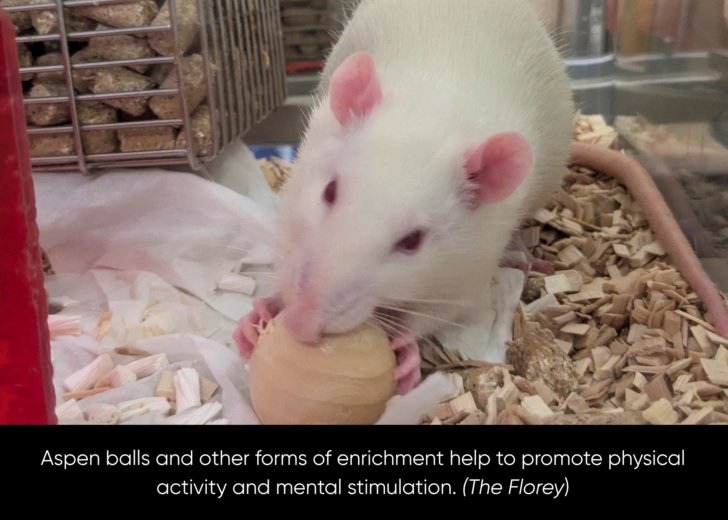
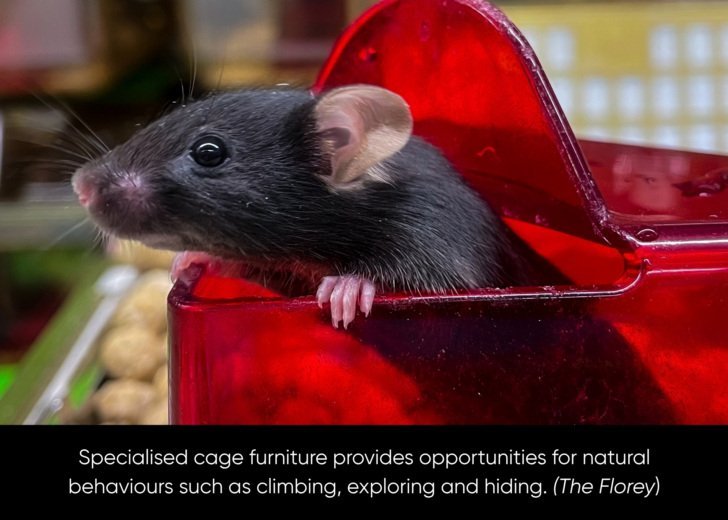
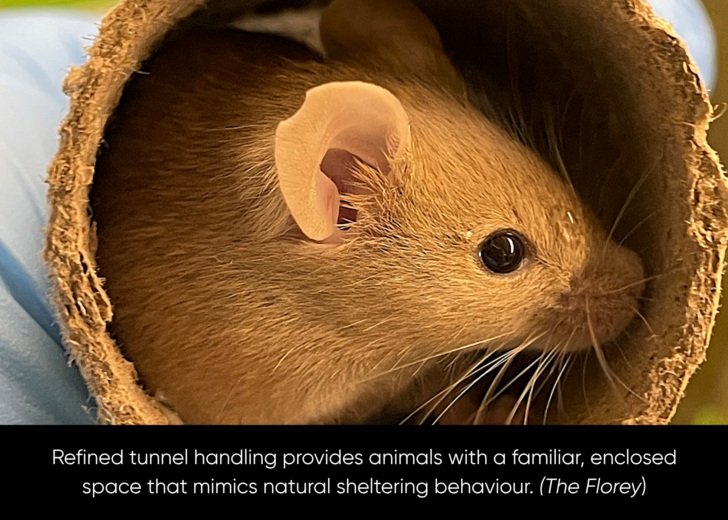
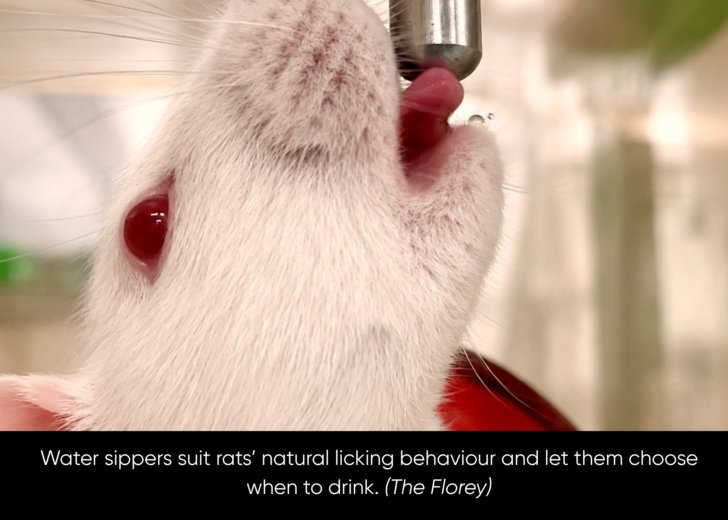
Animals within our care receive enrichment to encourage natural behaviours including sunflower seeds or mealworms for foraging, puzzle feeders for mental stimulation, and materials for nesting. Similarly, specialised cage furniture is provided such as houses, tunnels and lilypads, for the animal’s comfort. Animals benefit from positive social contact, which reduces stress. Positive reinforcement and familiarisation training methods are used to allow animals to become more comfortable with being handled. Likewise, we implement refined handling practices, such as tunnel or cup handling, which have been shown to reduce stress. We are committed to continuous improvement to advance animal welfare.
Contact us
If you’re interested in learning more about the use of animals in research at The Florey, please contact our Animal Ethics team.
Source information
All images on this page were captured inside Florey research facilities by our team of animal technicians. With thanks to Elissa, Mouse Breeding Barrier Supervisor, and Steph, Animal Technician.